
Harrisburg hosts a broad collection of organizations that operate under strict expectations for continuity, compliance, and timely service delivery. Legal offices, healthcare practices, public institutions, school systems, and logistics providers must maintain systems that withstand audits, workload fluctuations, and public scrutiny. Many operate with limited IT capacity or rely on disconnected tools that do not provide the oversight they require. Infradapt supplies a structured operations model that supports predictable performance, complete documentation, and clear accountability.
Our approach emphasizes control, monitoring accuracy, and process integrity. Whether your team works near the Capitol Complex, along major freight corridors, or within distributed administrative offices, we establish systems that remain consistent, secure, and aligned with your organizational mandate.
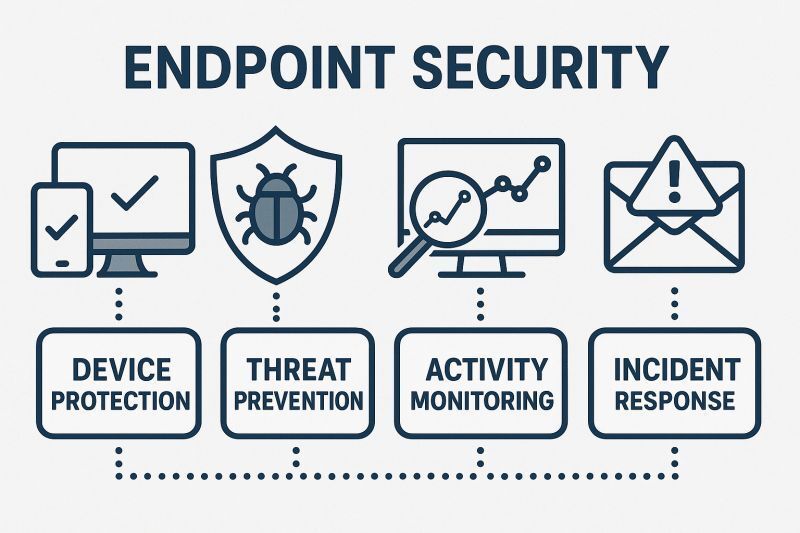
Our service model focuses on establishing controlled, documented, and repeatable processes. Each category below functions as part of a unified operations structure designed to maintain system integrity and reduce internal workload.
All incoming issues follow a formal intake process using phone, email, or portal submission. Requests are categorized, assigned, and tracked to completion with progress notes for leadership visibility.
Server health, network pathways, cloud functions, and endpoint performance are monitored continuously. Each alert triggers an internal review to determine its potential impact and corrective action.
Access enforcement, device compliance, threat detection, and data control measures are maintained according to documented standards. Controls are reviewed for accuracy and alignment with current risks.
We administer user rights, retention settings, authentication rules, and collaboration tools within Microsoft 365 and related platforms. All changes follow approval and logging procedures.
Backup jobs, restore tests, recovery instructions, and communication protocols are validated regularly. These activities ensure your organization can resume operations with minimal delay during an incident.
We produce lifecycle forecasts, asset evaluations, and modernization proposals supported by data. This prevents unexpected purchases and eliminates reactive decision making.
Harrisburg organizations must meet strict expectations for data management, service continuity, and regulatory adherence. Our support structure adapts to each sector without adding complexity to daily operations.
Our onboarding structure emphasizes transparency, system understanding, and operational continuity. Each stage contributes to a stable foundation that supports long term reliability.
Our service model benefits teams that require accountability, documentation, and reliable system performance. We create environments where technology supports the mission rather than distracting from it.
Yes. We compare your existing configurations to applicable standards and produce a list of required corrections, recommended enhancements, and documentation needs.
We evaluate each storage location, identify purpose and ownership, and consolidate information into a clear structure with designated access rules.
We establish vendor contacts, maintain configuration notes, and ensure updates do not interfere with other systems. These applications receive the same oversight as core platforms.
Yes. We coordinate directly with carriers, software vendors, and hosting providers to resolve incidents and maintain alignment with your internal policies.
We use centralized alerting, log analysis, and device audits to detect improper authentication attempts or unknown endpoints. Action is taken immediately when irregularities appear.
We enforce modern requirements for passwords, multifactor methods, and session controls. This reduces risk while creating a more consistent experience for users.
Staff who work offsite receive managed device configurations, encrypted connections, and defined access rules that follow the same standards as on site users.
Yes. We maintain an updated inventory that includes hardware specifications, licensing, account structures, and configuration notes.
We provide documentation, confirm technical controls, and assist in preparing evidence that satisfies audit requirements.
You can schedule a discovery discussion where we review your needs and determine the appropriate starting point. No commitment is required to begin the evaluation.

